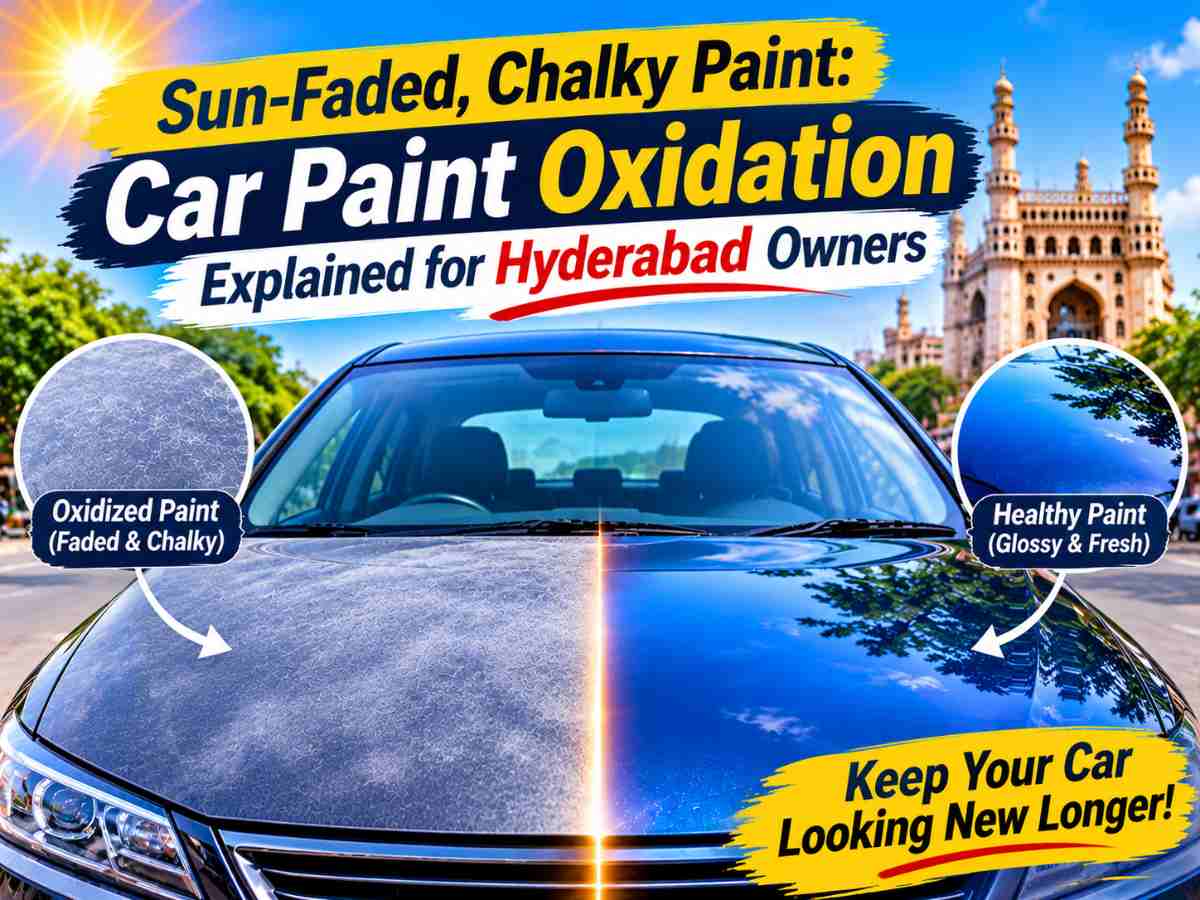
Quick answer: Car paint oxidation is sun and heat breaking down the top layer of paint, leaving it faded, dull and sometimes chalky to the touch. Light and moderate oxidation polishes out, restoring colour and gloss. If the surface is peeling, flaking or has white blotches on a clear-coated car, that’s usually clear coat failure, which polishing can’t fix; the panel needs repainting.
Park a five-year-old red hatchback next to a new one in a Hyderabad parking lot and you’ll see it straight away. The old car’s roof and bonnet have gone a dusty pink. Run your finger across the roof and it comes away with a faint red powder. The doors, which got less sun, still look closer to the original colour.
That’s oxidation. The good news is that a lot of it can be reversed. The bad news is that some of what looks like oxidation is something else, which can’t. Here’s how to tell the difference and what to do about each.
 01
What car paint oxidation is
Automotive paint is a set of layers: primer, then the coloured base coat, and on most modern cars a transparent clear coat on top. Older cars, and some solid colours, used single-stage paint, where colour and gloss are in one layer with no separate clear coat.
Ultraviolet light and heat slowly break down the resins and pigments in the top of the paint. Oxygen and pollutants join in. Over time, the surface becomes microscopically rough and porous, so it scatters light instead of reflecting it. The colour looks washed out and the gloss disappears.
On single-stage paint, that degraded top layer is pigmented, so it rubs off as coloured powder: that’s the classic chalky oxidation. On clear-coated paint, the clear coat itself takes the UV first. It can go hazy and dull, and if the breakdown goes far enough, it starts to fail.
Oxidation or clear coat failure?
This is the question that decides whether polishing will work. As Mike Phillips of Meguiar’s put it on the Meguiar’s forum, “Oxidation is a problem you really see with single stage paints, not clear coats.” Clear coats oxidise far more slowly, so severe “oxidation” on a newer, clear-coated car is usually clear coat failure. And if repeated polishing and waxing make no difference, he notes, nothing from a bottle is likely to fix it.
What you see | Likely cause | Can polishing fix it? |
|---|
Colour faded, gloss dull, surface smooth | Light oxidation | Yes, a polish usually restores it |
Chalky powder on your finger, colour transfers to a cloth | Oxidised single-stage paint | Usually, with compounding and polishing |
Hazy, milky clear coat, still smooth and intact | Early clear coat oxidation | Often, with careful correction |
White blotches, rough or scaly patches | Clear coat breaking down | Rarely; usually needs repaint |
Clear coat peeling or flaking at the edges | Clear coat failure | No; the panel needs repainting |
The roof, bonnet and boot lid go first, because they face the sky. Red, black and dark blue cars show it soonest.
 04
How oxidised paint is restored
Light oxidation
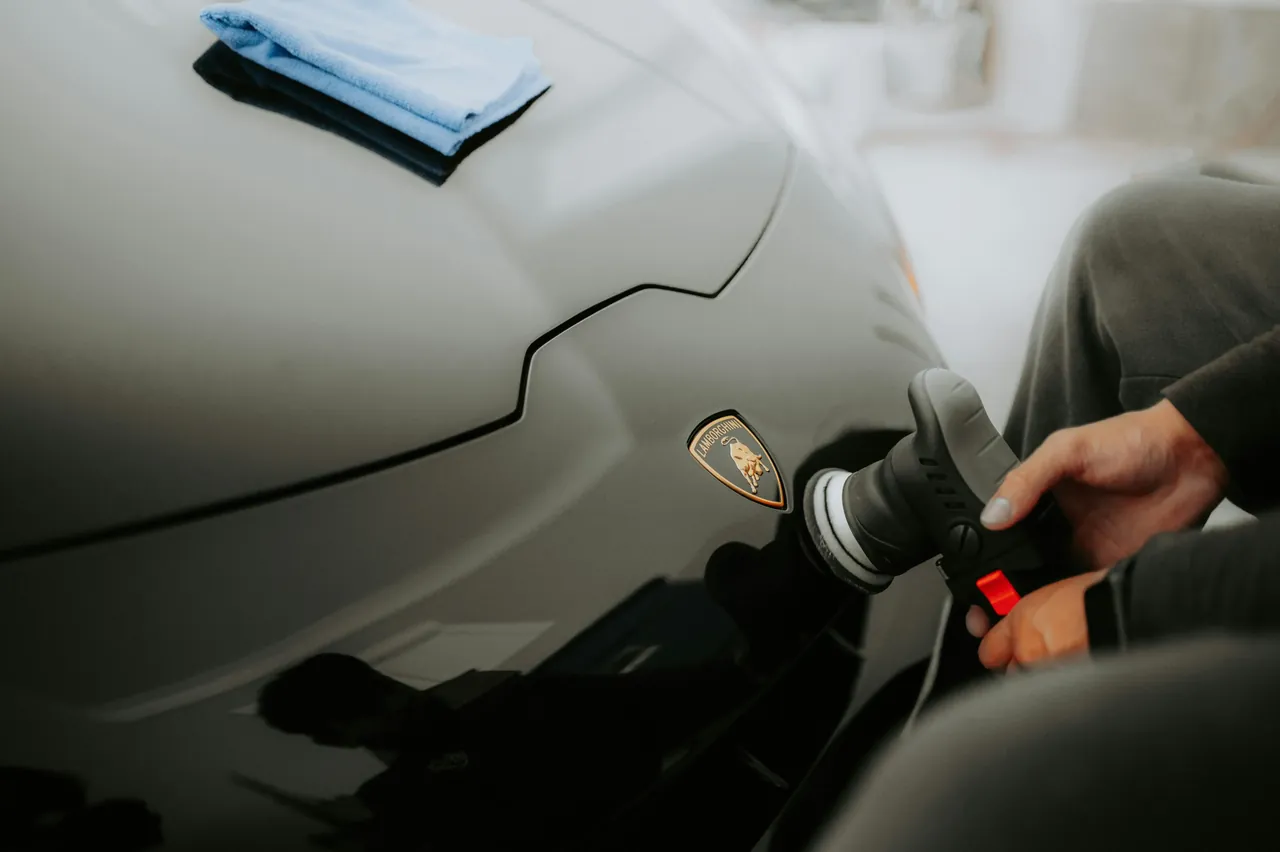
A single-step machine polish removes the thin degraded layer and brings back colour and gloss. Then the paint needs protection straight away, or it will fade again.
Moderate oxidation
Two-stage correction: a cutting compound to remove the heavier damage, then a finishing polish to refine the finish. The colour change can be dramatic, from dusty pink back to red.
There’s a limit, though. Your clear coat is only about 35 to 50 microns thick, according to Motomotar’s paint guide. A light polish removes about 1 to 2 microns; heavy compounding takes 5 to 7. That’s why a good detailer measures first, uses the least aggressive step that works, and won’t promise to polish every panel back to new. Polishing paint that’s already thin can cut through to the base coat, which turns a polishing job into a repaint.
Clear coat failure
If the clear coat is peeling, flaking or has gone white and rough, polishing won’t help. The panel needs to be sanded and repainted by a body shop. If a car has been repainted after an accident, it may also need correction to match the original panels; our post on what happens after an accident repaint explains why.
Our paint correction and restoration service covers oxidation removal with multi-stage machine polishing, and our post on how we restore damaged car paint walks through the process. Correction is done at the studio, with pick-and-drop in Hyderabad (and in Delhi NCR, Mumbai and Bangalore). We’ll tell you honestly if a panel is beyond polishing and needs a body shop instead.
What about “rubbing” at a roadside shop?
Heavy rotary compounding can make oxidised paint look shiny for a few weeks, partly because of fillers in the product. Done aggressively and without measuring, it also removes a lot of clear coat and often leaves swirls and holograms. If you’ve had that done repeatedly, the paint may not have much left to give. Our swirl marks guide explains what heavy compounding does.
Frequently asked questions
What is car paint oxidation?
It’s UV, heat and oxygen breaking down the top layer of paint, leaving it faded, dull and sometimes chalky to the touch.
How do I know if my car paint is oxidised?
Compare the roof and bonnet with lower panels, and run a finger across the roof. Faded colour and coloured powder on your finger point to oxidation.
Can oxidised car paint be fixed?
Light and moderate oxidation, yes, with machine polishing. Peeling or flaking clear coat can’t be polished and needs repainting.
What is the difference between oxidation and clear coat failure?
Oxidation is a dull, faded surface that’s still intact. Clear coat failure is the clear layer itself breaking down, showing as white blotches, roughness, peeling or flaking.
Does polishing remove oxidation?
Yes, by removing the thin degraded layer. Heavier oxidation needs compounding first. Each polish removes a little clear coat, so it should be measured and controlled.
Why does red car paint look faded so quickly?
Fading is easiest to spot on red, where it shows as a pinkish tone, and on black and dark blue. Lighter colours fade too; it’s just less visible.
How do I stop car paint from fading in Hyderabad?
Park in afternoon shade, wash regularly with pH-neutral shampoo, never dry-wipe, and protect the paint with a sealant or ceramic coating.
Does ceramic coating prevent oxidation?
It adds a hard, UV-resistant layer that greatly slows oxidation, provided it’s applied over corrected paint and maintained.
Can a roadside rubbing job fix oxidised paint?
It can make it shine briefly, often with fillers, but aggressive compounding without measuring can remove too much clear coat.
Does Royal Royce offer pick-and-drop for paint correction in Hyderabad?
Yes. Paint correction and coating are done at the studio, with pick-and-drop in Hyderabad, Delhi NCR, Mumbai and Bangalore.